International buyer's guide
The buying process, taxes and neighbourhoods, for buyers from abroad.
In-depth guides
 Buying processBuying property in Spain from abroad: a step-by-step guide for 2026A clear 2026 guide to buying property in Spain as a foreign buyer — from your NIE and financing to the notary, taxes and how your own agent protects you.
 Costs and taxesThe real cost of buying property in Spain: a 2026 guide to taxes and fees for foreign buyersWhat it really costs to buy property in Spain in 2026: transfer tax, VAT, notary and legal fees for foreign buyers — including Catalonia's progressive rates.
 NeighbourhoodsThe best neighbourhoods in Barcelona to buy property: a 2026 buyer's guideA buyer's guide to Barcelona's prime neighbourhoods: Pedralbes, Sarrià, Sant Gervasi, Eixample and the waterfront, with 2026 prices and who each area suits.
 Lifestyle and relocationLiving in the Maresme: the appeal of Barcelona's prime coastWhy the Maresme and its exclusive Supermaresme offer Barcelona's finest coastal living: sea, space and the city 25–45 minutes away by train. An insider's guide.
Short answers
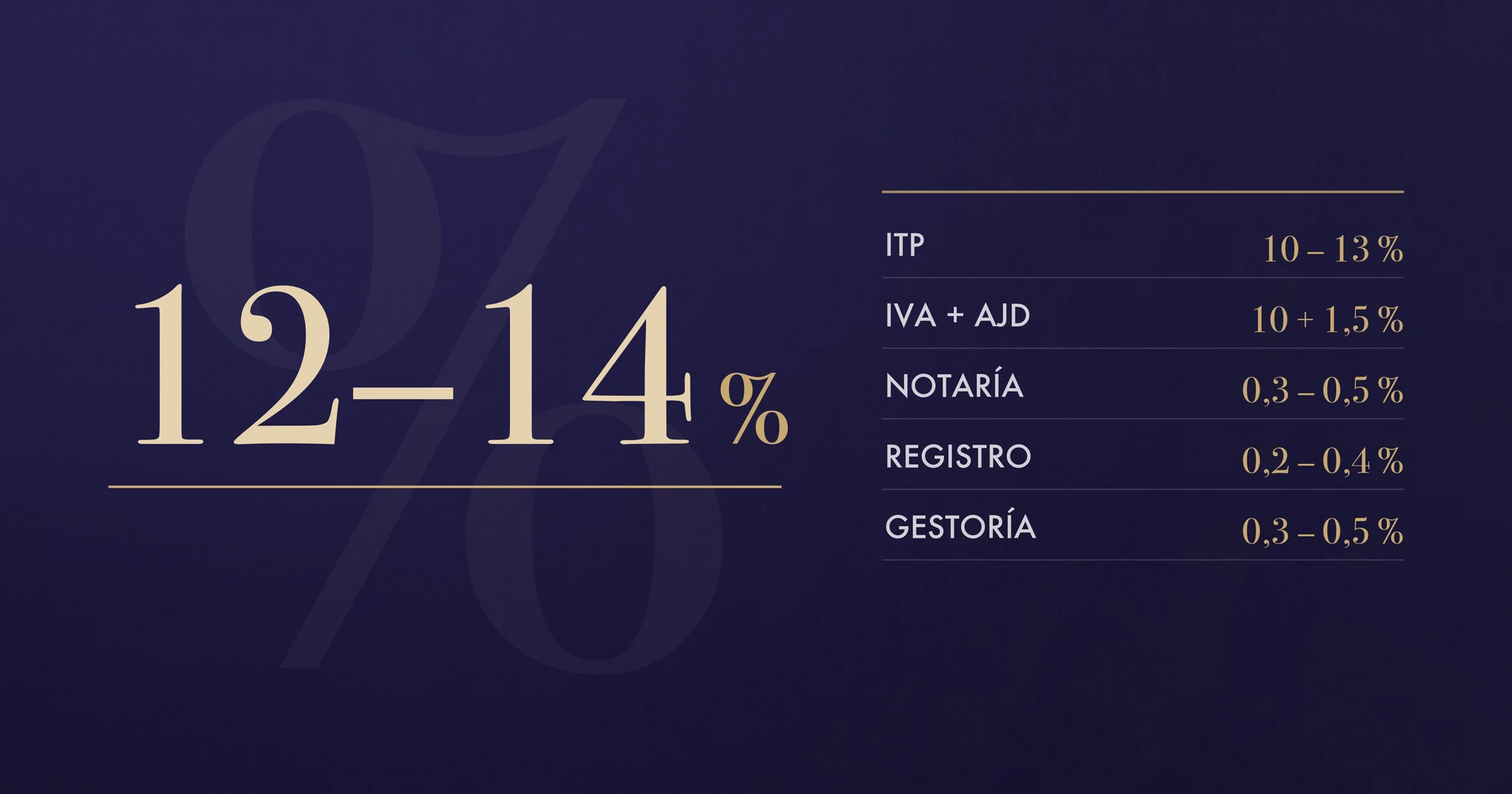
ITP is the transfer tax paid by the buyer of a resale home. Each region sets its own rate. Catalonia has applied a progressive scale since 27 June 2025: 10% up to €600,000, 11% on the portion from €600,001 to €900,000, 12% from €900,001 to €1,500,000 and 13% above €1,500,000. The rate is derived from the value of the whole property, so co-buyers do not each get the lowest band. It is payable within one month of completion. There is a full breakdown in my guide to the real cost of buying in Spain. Correct as of August 2026.
On top of ITP or VAT, budget for notary fees (typically €600–€1,200), Land Registry fees (€400–€1,000), legal fees (around 1% for a prime purchase), a gestoría, and a valuation if you are financing. All in, a foreign buyer should plan for roughly 11–14% on top of the price on a resale, and around 13% on a new build. On a resale the share rises with the price, because the transfer tax is progressive: above €1.5M, plan for the upper end. Correct as of August 2026.
There is no single rate. It depends on the service — selling a property, searching on behalf of a buyer, finding a rental — and on the specific task, so it is agreed individually and set out in the contract before work begins.
As a rule, the seller, under their own agreement with the agency. If you hire your own agent to search the whole market and negotiate on your behalf, that service is paid for under a separate written agreement, made before the search begins.
On a purchase an agent helps with the search, the price assessment, checking and preparing the documents, negotiating the terms and coordinating the notary and the bank, and sees the purchase through to completion. I will set out the services for your own brief in writing.
I work most often in Barcelona and Catalonia: that is where I know the streets, the buildings and what things actually sell for. I work across the rest of Spain too, and I tell you at the outset when I am assessing an area together with a local colleague. Outside Spain I do not claim that expertise: CENTURY 21 has offices in almost 80 countries, so if you need someone in Lisbon, Dubai or Miami, I introduce you to a colleague there and stay copied in until you are in good hands.
Yes, non-residents do get mortgages from Spanish banks. I go through your situation in advance: I set out the financing options open to you, which documents you will need and how to evidence your income and the source of your funds, I help you assemble them, and I arrange the conversation with the bank. The application itself is filed by the gestoría I work with — I stay copied in and keep an eye on the dates, so approval does not hold up the purchase. The bank sets the terms, so I will not promise you a rate in advance.
Two to four weeks from an accepted offer to signing, if you are paying cash. Roughly a week for the checks and the money, a week for the notary to prepare the documents, and about three days to sign. With a mortgage the whole purchase takes four to six weeks: the bank’s own review is about ten working days, two weeks at most. Once I know your situation I give you dates rather than a range.
I stay in touch after the purchase. I see the property registration through, and help with the move, settling in and finding contractors worth trusting. Property management and rental coordination I can take on as well — that is not part of every purchase, so we agree it separately. Tax goes to the gestoría I work with, legal questions to a partner lawyer, and if you want the investment side looked at properly I put you in touch with a partner who does that. I stay copied in throughout, so you are not left to work things out alone. The relationship does not end at the notary.
For general information only; not a binding offer.
Download the Barcelona guide
Relocation, neighbourhoods, real prices and a district comparison, sent to your inbox in a minute.